
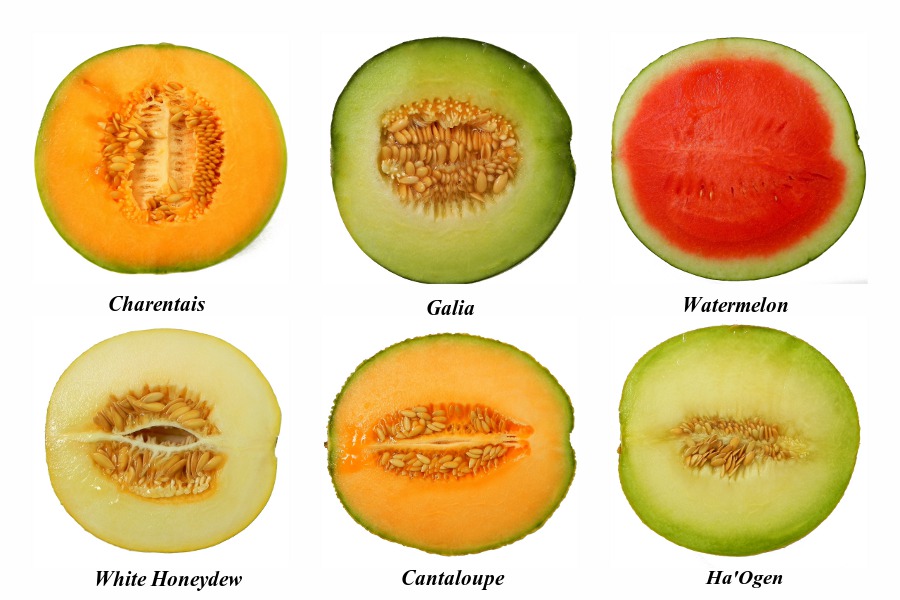
*** CLICK MELONS TO SEE INSIDE ***
Words used to describe melons include perfumed, juicy, succulent, voluptuous, sweet, and honey flavored. A melon is one of the most sensual and tactile fruits. Smell the heady fragrance, touch the rough netted or smooth skin, taste the juicy flesh. Don’t let the summer pass you by without enjoying this beautiful fruit. If you’ve only eaten watermelon, it’s time to try something new. You’re in for a treat, as there are more varieties in grocery stores and farmers markets than ever before!
Classifying Melons
Melons come in many shapes, sizes, and colors. They are part of the gourd family (like pumpkins) as evidenced by their tough skin and numerous seeds. Melons grow on a vine that creeps over the ground and takes up a lot of space. They require a long season of warm, sunny days to produce fruit and can be harvested from late summer to early fall. According to The Deluxe Food Lover’s Companion, there are two species of vines that produce melons. Watermelons come from one species and the other species produces European cantaloupe, muskmelon, and winter melon.
Watermelon
Several varieties of watermelon exist, and they all have the same sweet, watery, crisp flesh. Watermelons can be large (up to 35 pounds!) and oval or small and round. The rind can be solid green or green and white striped. Their flesh ranges from ivory to yellow, pink or red. The shiny, black seeds are scattered throughout the flesh. Seedless watermelons actually have seeds, but much fewer and they are soft and edible.
European Cantaloupe
Charentais has a smooth pale green skin with beige undertones and dark green grooves from stem to blossom end. The flesh is a brilliant orange and dripping with juices. This variety is revered as the most succulent and delicious of all melons. It’s a French melon that is also cultivated in the United States.
Galia is similar in appearance to a cantaloupe, with a netted rind that is more golden in color. Its light green flesh is more watery and refreshing than rich and succulent. Use the Galia quickly, as it deteriorates fast once ripe.
Ha’ Ogen is a Hungarian heirloom variety (associated with Israel) with a yellow rind and dark green grooves. The flesh is pale green with a refreshing, juicy texture and sweet, tangy flesh.
Muskmelon
aka netted melons for the appearance of their skin. These must be plucked from the vine when ripe, as they will not ripen further off the vine.
American cantaloupe has a raised, netted rind that turns beige when ripe. This is the melon we are most familiar with in the united states (other than the watermelon). The flesh is orange, juicy, and sweet.
Winter Melons
These melons don’t appear in markets until late fall, but are good storage melons because the will ripen off the vine.
Honeydew melons have a creamy-yellow rind that is smooth to the touch. They are more oval than round. Honeydew melons have been celebrated for thousands of years for their very sweet and juicy flesh. The standard honeydew shows a pale green flesh, but it also comes in varieties with orange or gold flesh. The Deluxe Food Lover’s Companion gives a tip that perfectly rip honeydew melons have a very slight wrinkling that can be felt on the surface.
Purchasing, Storing, and Eating Melons
Rachel Saunders of Blue Chair Fruit advises that the stem end of a ripe melon should smell “musky and fruity.” In many varieties of melon, the blossom end will be a bit soft when ripe. Pick melons that are heavy for their size. The flavor and aroma of a melon is dulled by cold temperatures in the fridge. For this reason, it’s best to enjoy a melon at room temperature. Once you’ve cut into the fruit, it can be stored in the refrigerator, wrapped well in plastic for about 5 days. Nutritionally speaking, melons are made up of 90% water. According to The Produce Bible, melons are a source of vitamin C and beta-carotene (those with orange flesh having more).
Cooking with Melons
The flavor of a perfectly ripe melon is mostly enjoyed raw in salads, puréed chilled soups, and salsas. Sliced melon goes well with salty cured meats on an appetizer tray. With added pectin, an orange-fleshed melon makes a lovely jam. The sweet, fragrant melon is good for frozen dessert like a sorbet or granita. Alcohol balances the sometimes cloying sweetness of melons in fruity cocktails. Pickling watermelon rind is a technique used in Asian cuisine.
Flavor Pairing
lime
fruity olive oil
honey
yogurt
red onion
chili peppers
tequila and rum
pistachios and almonds
greens like arugula or watercress
herbs: mint, basil, parsley, dill
cured meats like prosciutto
grilled foods like chicken or seafood
cheeses like mozzarella or goat cheese
Do you have a favorite melon variety or way to prepare melons?
Let me know in the comments section. Click Here.
I love the layout of your blog! The photos are beautiful too. I’m looking forward to looking through your past posts 🙂
Thanks, Rachel! I really appreciate it!