
Growing Carrots
This is my first year growing vegetables in a community garden plot and I’ve really enjoyed cultivating carrots. My 10×20 foot plot is separated into 3 mini-plots, one of which I devoted to carrots and beets this spring. I grew multicolored varieties ranging from orange to yellow to purple and they are all tasty! As a first time gardener, I was surprised at how difficult it was to pull the mature carrot from the ground. Pretty much a two person job. After many failed tries where I yanked on the carrot top with all my strength and flew 10 feet across the garden, I sought help from a strong neighbor. He had a smart method which involved him shoving a pitch fork into the ground at an angle to force the carrots upwards while I pulled. We had the whole bed harvested in no time at all. As I pulled the carrots from the ground I was completely overwhelmed by their aroma- so fresh, green, and earthy. Once you’ve experienced this scent, you’ll truly understand the allure of the Apiaceae family of vegetables.
According to Rodale’s Illustrated Encyclopedia of Organic Gardening, carrots are a family of crops (Apiaceae) that includes celery, celeriac, fennel, parsley, parsnip, and chervil. Carrots require fine soil. Plant them in stony soil and their roots will grow into a fork shape. Carrots don’t transplant well but they do tolerate cool soil temperatures so direct sowing of carrot seeds into the ground is the way to go. Rodale’s Illustrated Encyclopedia of Organic Gardening warns against carrot rust fly, a pest that shows up in late summer attracted by the aroma of bruised carrot leaves (caused by thinning). Prevent this by sowing seeds farther apart so you don’t have to thin the plants. Also, some suggest that the aroma of chives or onions growing amongst carrots keeps carrot fly away. Carrots may be sown and harvested throughout the year. They can be overwintered in the garden or harvested and stored in a root cellar. The carrots of spring and summer are sweet and tender, while the carrots of winter are large with a woody core that may need to be removed. Carrots take a while to develop- many varieties may take 10-11 weeks.
Varieties
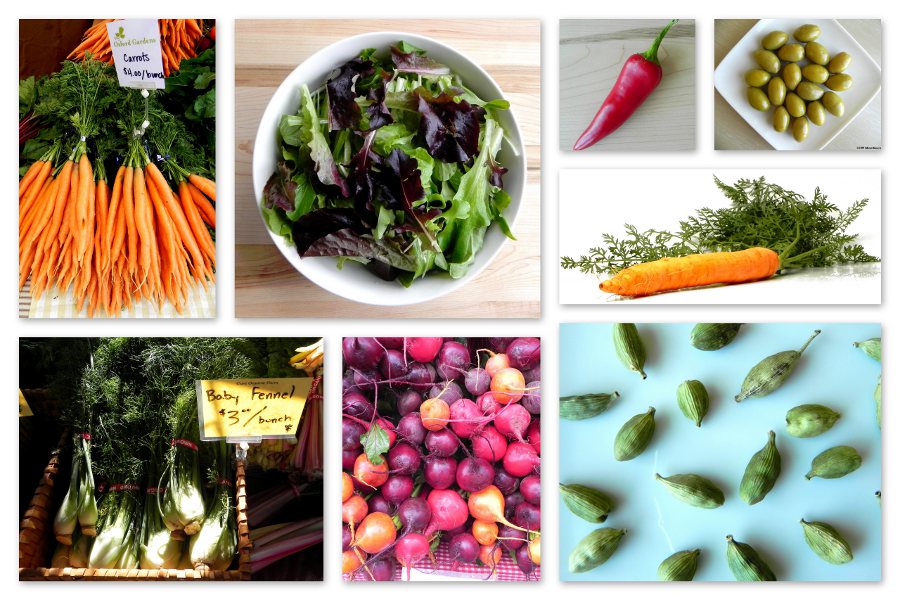
Carrots are classified into two categories: early and maincrop. The Kitchen Garden defines early carrots as those sown in early spring, and maincrop as those sown in May or June. In Chez Panisse Vegetables, Alice Waters writes “the greatest abundance of fresh sweet carrots comes in middle to late summer.” We’re all familiar with the long, cylindrical, tapered orange root identified in Chez Panisse Vegetables as the Imperator variety. Did you know carrots can be purple or yellow or even white? The shape varies from small, golf ball shaped round carrots to cone shaped to the cylinder shape that does not taper. The next time you visit the local farmers market, keep your eyes peeled for the uniquely shaped and colored carrots.
Selection and Storage
Always choose carrots that are firm with smooth skin. Avoid carrots that are soft with discoloration, as this is a sign of disease and decay. If the tops are attached look for bright, perky greens that smell fresh like parsley. Once you get the carrots home, remove the tops and the vegetable will keep longer. Carrot tops add a spicy parsley-like flavor to soups and salads. I’ve found it’s best to store carrots wrapped in a plastic bag, but not sealed. Carrots left uncovered in a vegetable crisper go soft and bendy in a day. Avoid peeling small, freshly harvested carrots as you will remove much of their flavor. Just scrub them clean. Larger carrots should be peeled and if there is a woody core it should be removed in preparation for cooking.
Cooking
Carrots are delicious caramelized by a roasting hot oven. They are delicate and sweet boiled and served with butter and a sprinkling of herbs. Sweet, crunchy carrots are fantastic pickled in vinegar. Intensely flavored summer carrots taste delicious pureed into a soup, added to minestrone, or served in a salad. The holy trinity is a base for soups and risottos: carrots, onion, and celery. Carrots also add a very important sweet, earthy flavor to stocks.
Flavor Pairing
- Roasted Carrots with woody herbs like rosemary, thyme or oregano
- Spiced with cumin, sesame seed, curry, cardamom, saffron, fennel seed, coriander
- Spring rolls with cucumber, cabbage, mushrooms, scallions
- Roast carrots under a chicken with potatoes
- Olives: black and green
- Carrots are delicious in a salad or roasted with other vegetables like beets, fennel, and turnips
- Garnish carrots with delicate herbs like cilantro or mint
- The sweet + heat combo is so good: carrots with chili peppers
- Garlic, shallot
- Harissa
- Ginger
- Honey
- Mustard
- Balsamic vinegar
- Sesame oil
- Lime
Do you have a favorite carrot recipe or flavor pairing? I would love to see it in the comments section- Click Here.
This is my first year of gardening, too. Unfortunately, our weather hasn’t entirely cooperated but I’ve had such a great time learning the ropes. And, what great information about carrots! I especially love them roasted simply with coriander compound butter and a little orange zest.
I think compound butter is a wonderful thing and coriander/orange sounds delicious! Maybe you’ll have some better results gardening this fall, fingers crossed.