
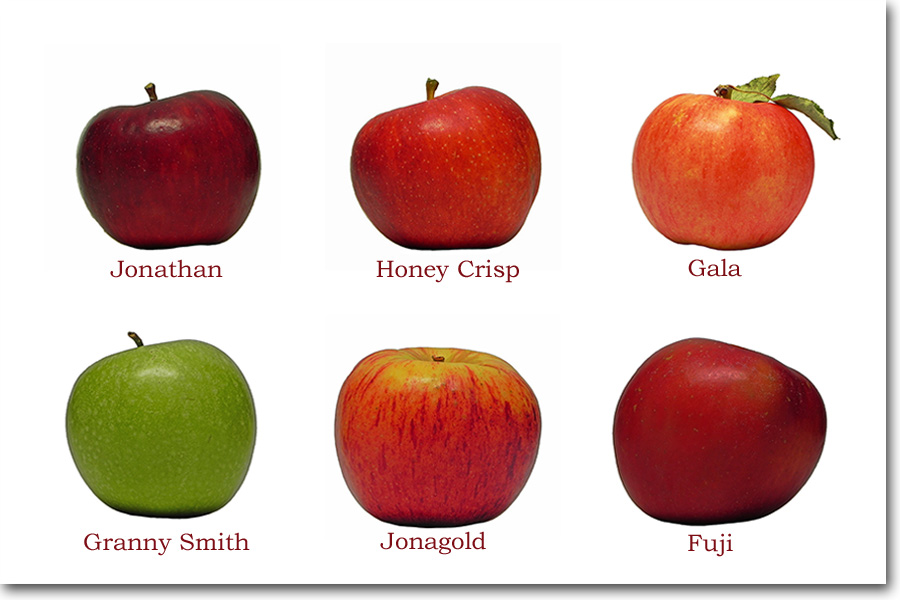
Next to tomatoes, apples are a prime example of a fruit that has been bread out of flavor in the industrialized food system. It’s so important to support farmers who tend to apple orchards because they are guardians of unique heirlooms that would otherwise be extinct. Reading Jamie at Home, Cook Your Way to the Good Life, by Jamie Oliver, I learned that there are more than 7,500 varieties of apple across the world! Diversity is good for mother nature, and for keeping our food supply healthy. Enjoying a variety of apples stimulates the senses and makes life more interesting.
Growing
When planting an orchard, think about apples for eating and cooking. Think about when the apples will ripen and choose cultivars that ripen at different times for a nice long growing season. You can also keep apple trees in containers. Apples need to be cross-pollinated from other apple trees that flower at the same time.
Storing
Some apples store better than others, and all apples kept in storage will eventually lose their flavor and juiciness. I learned from The Produce Bible that apples continue ripening after picking, and should stay good in a breathable bag in the refrigerator for about a week. Apples meant for long-term storage should be wrapped individually in tissue paper and kept in a cool, dark place.
Varieites
According to The Produce Bible, all modern day apples can trace their roots back to the ancient sour crab apple from what is now known as Kazakhstan. Apples belong to the rose sub-family, Maloideae. I’ve listed six varieties below, but know that there are many more out there.
- Fuji
Fuji apples are a cross between Red Delicious and Ralls Janet and were originally bred in Japan. The flavor is very sweet, juicy and crisp. It’s good for eating out of hand or used in applesauce. You can slice Fuji’s thinly and bake them into apple chips as well.
- Gala
This cross between Cox’s Orange Pippin and Golden Delicious is from New Zealand. Gala apples are one of the first to be harvested in autumn. They are sweet, crisp, and juicy. Though Galas are delicious eaten out of hand, they also hold up nicely to cooking. I like to use them in apple butter, apple sauce, or even apple pie. Gala apples soften without completely breaking down when heated, which gives purées more body.
- Jonathan
This dark-red skinned apple has a spicy aroma and is less sweet (more tart) than other varieties like Fuji and Gala. It’s best eaten out of hand or combined with other apples in applesauce. Jonathan apples are good for juicing and making cider as well.
- Jonagold
According to the Deluxe Food Lover’s Companion, Jonagolds are one of the best culinary apples, probably because its sweetness is balanced by crisp acidity and you can eat it out of hand or cook it. Jonagolds are a cross between Golden Delicious and Jonathan apples, originally from New York. I like to use Jonagolds in savory dishes like pork roasted with apples and cider. Their flavor holds up nicely and they keep their shape.
- Granny Smith
These are the Kermit-the -frog green apples with a seriously tart flavor and firm, juicy texture. Use them in apple pies, sliced thin on a sandwich, or grated in doughnut dough. According to the Produce Bible, Granny Smith apples were named after Maria Ann Smith in Australia.
- Honeycrisp
I learned from Russ Parsons in How to Pick a Peach that this apple was developed at the University of Minnesota and introduced in 1991. Honeycrisp is a fitting name, as this apple has an especially crunchy texture and a mellow sweetness balanced by bright acidity that makes it delicious just eaten out of hand. Some prefer not to cook with it, as the Honeycrisp stays a little too firm no matter how long you cook it. It seems to me the Honeycrisp is a good variety for cakes and tarts where you want the apple to maintain its shape for the visual effect. The claim to fame for this apple is that it can be stored for up to 6 months without deteriorating.
Cooking
In the River Cottage Cookbook, Hugh Fearnley-Whittingstall writes, “The distinction between eaters and cookers can be a misleading one…the more useful distinction is between apples that keep their shape when cooked and those that dissolve into a purée.” When choosing an apple to work with, consider whether you want applesauce or a detailed tart with perfect slices. Apples to be eaten out of hand should be crisp with sweetness balanced by acidity. Some apples are too tart or hard to enjoy out of hand, so we cook them into a purée sweetened with sugar and spices. Peeled or cut apples must be kept in acidulated water or they will oxidize and turn brown. Apples are rustic and satisfying when cooked slow by baking or stewing. Use crisp, sweet apples raw in autumn salads with nuts and cheese. Apple sauces and chutneys are a lovely partner to roast pork or sausages. Comforting apples are meltingly delicious in desserts like cakes, pies, tarts, crumbles, and turnovers. Apple sauce is also used to moisten and sweeten vegan baked goods.
Flavor Pairing
– Spices: cinnamon, clove, nutmeg, star anise, caraway, coriander seeds, curry, vanilla, cardamom
– Salad greens: spinach, arugula, watercress, bitter greens like endive and radicchio
– Vegetables: celery, beets, potatoes, fennel, parsnips, turnips
– Dairy: butter, cream, cheddar cheese, goat cheese, blue cheese, creme fraiche,
– Herbs: Sage, thyme, lovage, rosemary
– Fruits: pears, raisins, quince, blackberries
– Pork: sausage, ham, game
– Nuts: walnuts, hazelnuts, almonds
– sugar, maple syrup, honey
– brandy
What is your favorite apple variety? Let me know in the comments section. Click Here.
Lovely pictures! My favorite apple is the Gala.
I’m actually -weirdly- not a huge fan of apples. Maybe because they come right after my favorite fruits (stone fruits) go out of season? But, when I do eat one, I most prefer to dig into a crisp Pink Lady. Great name, too 😉
I read recently that the flavor of Pink Lady apples has a “hint of champagne.” So fitting!
I love the old, tremendously tart varieties like Thomas Jefferson’s purported favorite Esopus Spitzenberg or Cox’s Orange Pippin. Very hard to find, but so memorable (and usually ugly).
I like a tart apple too, Suzanne. Thanks for visiting!
We have one more variety here which is my favourite – Pink Lady! I love apples!