
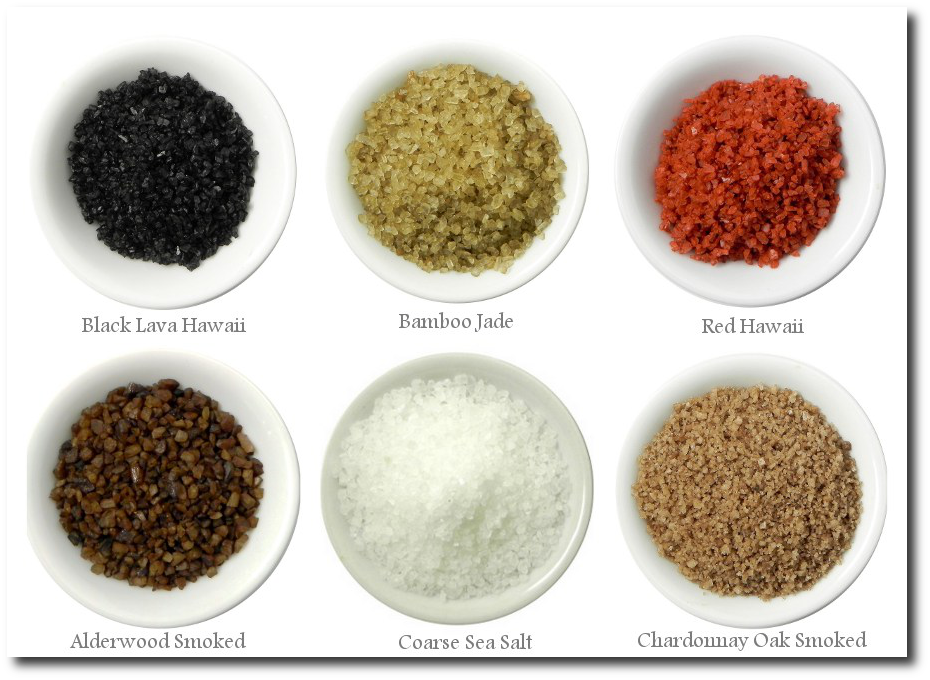
Salt
Many of us see salt as a common pantry ingredient, a necessity. We don’t think about it too much. We’re not aware of how salt is produced or who works hard all day to make sure this product is available for our dinner table. We’re not too concerned with working conditions or how salt harvesting methods affect the environment.
This week while researching salt, I had a light bulb moment.
I realized that salt can be a hand-harvested, artisanal product. Salt is no different than other products like coffee, tea, cheese, meat and poultry. Why would I strive to support small organic farms and cast a blind eye towards artisanal salts? Talk about a compartmentalized view!
After reading the book Salted: A Manifesto on the World’s Most Essential Mineral, with recipes, I began to see salt through Mark Bitterman’s eyes. He writes that salt is “a natural, whole food, intimately tied to a place and a way of life.” I realized that by seeking out hand-crafted salts, we support a market of diversity, preserve traditions, and promote sustainability.
This week, why not pick up a handcrafted salt and see how it tastes? Handcrafted salts are like heirloom tomatoes- diverse. They’re interesting. Wake up your palate with a smoked sea salt or a delicate Maldon salt from England. I encourage you to try something new.
The Importance of Salt for Survival
We cannot live without Sodium Chloride. This mineral is essential to human survival. According to Salt: A World History, Chloride is needed to perform respiration and digestion. Sodium is important at the cellular level for transporting nutrients and nerve impulses. The heart needs sodium to beat. Sadly, salt has become unpopular and some believe it is “bad for you.” I have two responses to that misconception:
#1 Processed foods that come from a box or fast food chains are unhealthy because they contain exorbitant amounts of sodium. This is a big problem in our world today. Have you heard the suggestion to only shop the perimeter of a supermarket? It’s a good one, because the center isles of a supermarket are full of boxed food, while the perimeter is where you’ll find fresh veg, dairy, and meat.
#2 Everything in moderation. If you are cooking you can control the salt in your food, learn how to salt before, during, and after the food has cooked. Taste as you go. This will help you avoid over-salting food at the table. Salt should bring out the flavors of other ingredients. If you can taste salt, it’s too salty.
How Salt is Made
I have here a very brief overview of mining practices, just to give you an idea of where salt comes from. This is a complex subject and you can read more about it in the book Salted. Salt production can be categorized as industrial or artisanal. Industrial practices use machines and energy (often from oil) to produce huge quantities of refined, uniform salt. Artisanal methods are rooted in history, depend on manual labor and mother nature, smaller in scale, and celebrate the unique character of salt from a particular region.
Industrial Salts
Reading Salted, I learned that the goal is to achieve low cost operations and purity of sodium chloride. Rock salt is taken from the earth with diesel-fueled mining machines. Another method of salt production uses vacuum pan evaporation (evaporated salts), which involves pumping water through underground salt deposits and adding chemicals to remove other minerals. The brine is boiled in vacuum evaporators until all that’s left is salt crystals. This is how kosher and other refined food salts are made. Salt is also made at industrial solar evaporation fields around the world. Water is evaporated until the salts crystallize and then bulldozers are used to harvest the salt. Much of the salt produced this way is intended for industrial use, like keeping our roads from freezing.
Artisanal Salts
Nature plays a big role in artisanal salt production. While industrial, refined salts are perfectly uniform, artisanal salts have their own personality. The shape and size of crystals varies, as does the color. Minerals are what makes gray salt gray. Iron gives salt a pink color. Black salts get their color from activated charcoal, which lends an earthy flavor.
Salt marshes are managed for efficiency, utilizing the benefits of mother nature’s geography, tides, and climate. Many use renewable energy. Evaporative salts are made by allowing the sun and wind to crystallize salts or heating the brine over a fire. While industrial producers seek a pure end product, artisanal producers allow other minerals to crystallize during the process to enrich the flavor and nutrition of their salt. Salt is mostly harvested by hand using special wooden tools, with care not to damage the salt marsh. Certain salts are cultivated in marshes and can be harvested daily, while others like fleur de sel only bloom when the conditions are right (warm sun and wind), and must be carefully harvested before they sink. Greenhouses are used to evaporate salts in rainy climates. Rock salt is mined in rugged terrains like those of Pakistan (referred to as Himalayan salt).
Cooking with Salt
The primary function of salt is to awaken the flavor of other ingredients. According to Tom Colicchio in Think Like a Chef, with salt “sweet flavors become sweeter, the acids become brighter; all the flavors in the dish become more vibrant.” I believe one of the hallmarks of an intuitive cook is a mastery of using salt while cooking, not just at the end. In Salt to Taste, Marco Canora writes, “The best cooks I know rely mainly on their senses; they taste, smell, listen, and watch what they are cooking in order to determine what is needed to achieve the effect they want.” He recommends taking a couple of factors into account when salting to taste: salty ingredients in the dish like Parmesan or bacon and how a simmering sauce concentrates flavors including saltiness. Food can be salted prior to being exposed to heat, during cooking, and at serving. Judy Rodgers advocates “the practice of salting early” in The Zuni Cafe Cookbook. Judy writes that salting early allows the seasoning to really penetrate meats and poultry, while increasing juiciness and improving texture. Check out her book for more on this technique, which she uses on large cuts of meat like pot roast and roast chicken. This technique could change your world a little bit, in a really good way.
Other ways to use salt include curing meats and fish, pickling vegetables, and preserving lemons. Coarse gray salt provides a pleasant crunchy texture to grilled meats while enhancing their flavor. Water for cooking pasta should be salty like the sea, as this is your only chance to season pasta without it tasting like salt. Rock salt makes a beautiful bed for presenting oysters. Salt conducts heat and retains moisture in recipes for whole fish baked in salt crust. Flavored salts like salts like smoked, truffle, herb, garlic, or celery can add interesting dimension to a dish. Desserts take on a savory note with the addition of salt (especially smoked salts). I hope you get out there and really explore all the different possibilities for using salt.
What is your favorite salt? Let me know in the comments section. Click Here.
Oh how I love salt. Definitely a misunderstood, but essential, ingredient.
Murray River pink salt from Australia is my favourite. Delicate granules and so, so pretty.
Thanks for sharing- I am going to look for it.
What a great post! I too think salts are underrated and really have a subtle but important impact in dishes… favorite salt to use for all around purposes is still Maldon!
Thanks for reading, Karen. I love Maldon too- especially on a simple salad of garden fresh greens with olive oil.