
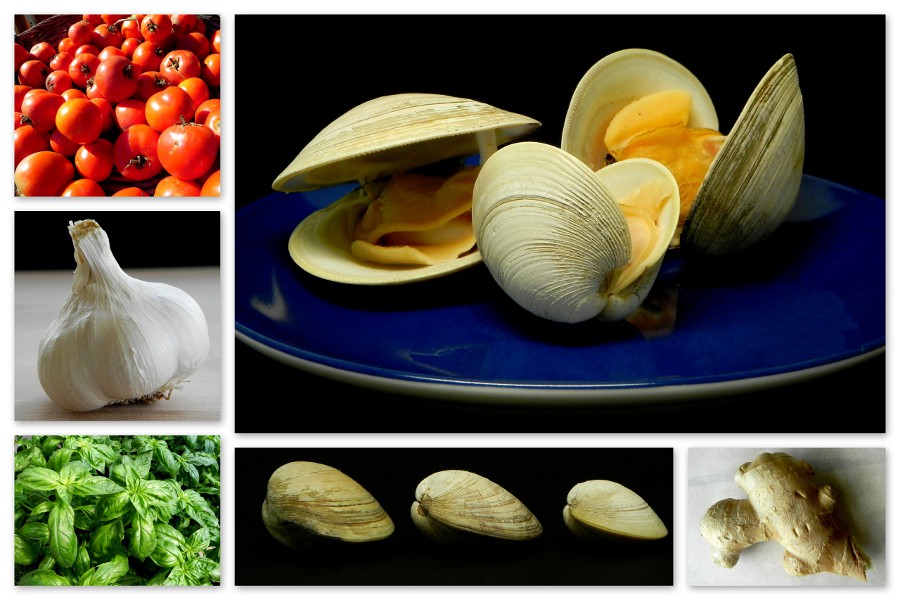
I think we’ve taken clams for granted. They often play a supporting role in dishes to add visual and textural variety. A recipe for paella or fish stew might call for a handful of clams. However, clams are delicious in their own right. They’re also quick cooking, healthy, and flavorful. Reasonably priced clams are a great way to shake things up, adding variety to your cooking. Summer vegetables pair beautifully with clams. If you don’t typically cook clams, I urge you to get out there and try something new! Clams are best simply prepared, perfect for the lazy days of summer.
Aliza Green’s book, Starting with Ingredients, contains a whole chapter on clams. She writes that “clams are bivalve mollusks of various species that live buried in mud or sand.” Clams use a muscular foot to move around. The word “bivalve” refers to the clam’s two shells that are attached like a hinge with a ligament. Aliza reports that clams can live for more that 150 years!
Clams have a sweet, buttery taste and clam juices are prized in the kitchen for their subtle ocean flavor. Their flesh is a creamy pinkish-tan color that should be moist and firm. A fresh clam smells of the sea and nothing more.
Clams can be tiny, smaller than two inches in diameter, or large like the East Coast Chowder Clam or Pacific Northwest Geoduck. The Monterey Bay Aquarium Seafood Watch lists worldwide farmed clams, Atlantic soft-shell steamers(wild-caught), and the Pacific Geoduck(wild-caught) as Best Choice. This means that these populations are “abundant, well-managed and caught or farmed in environmentally friendly ways.” East Coast and Pacific Northwest clams are available year-round. California clams are available November through April.
Varieties
There are many varieties of clams, here I have noted the ones you are most likely to find in the United States:
Hard-Shell Clam
It has a thick, grayish-white shell with purple coloring on the inside. The habitat for hard-shells is in sandy coves along the beach. Small hard-shells (little necks) are more expensive than larger ones, as their flavor is sweeter and texture less rubbery. Cherrystones are a bit bigger than Little Necks. The largest hard-shell clam is the chowder or quahog. It can be over 3 inches in diameter and weigh as much as half a pound.
Soft-Shell Clam
These clams, known as steamers, are popular in New England. The foot protrudes from the clam shell, keeping it from closing completely. Soft-shell clams have a thin, brittle shell. In New England steamers are enjoyed simply as their name implies, steamed. They are also delicious fried.
Razor Clams
A clam with a long, thin shell that is shaped like a razor blade. In the United States razor clams are found on the Pacific Coast. Rick Stein describes the flavor of razor clams as sweet and slightly peppery. It’s easy to overcook a razor clam, so the best preparations involve a quick stint atop the grill, a ceviche, or tossing the shucked clams in hot pasta or sauce.
Geoduck Clam
{gooey-duck} a 6-inch-long clam with a neck that can reach up to about 1 1/2 feet. These dude is crazy-looking. I learned from the book, Starting with Ingredients, that geoduck means elephant trunk clam in Chinese.
Purchasing & Storing Clams
According to Rick Stein’s Complete Seafood (James Beard cookbook winner), all raw bivalves should be alive. The shells should be tightly closed or should close when tapped on a counter. Discard any that are open or broken. Soft-shell clams will not close completely, but should be alive and moving when stimulated. Store clams covered in seaweed or a damp cloth in the fridge. I don’t cover them all the way because they need a bit of air circulation to breathe. The clams will stay alive for a few days in the fridge. Clams are also sold canned in their own juices. Try several producers to determine your favorite. In Spain, high quality canned seafood is served for an appetizer with drinks. Bottled clam juice is easily found in the grocery store. Use one with no artificial ingredients to add depth to seafood dishes, soups, and sauces.
Cooking
In the River Cottage Cookbook, Hugh Fearnley-Whittingstall writes that clams should be rinsed under cold running water and scrubbed before cooking. He instructs that razor clams are quite sandy and need to be rinsed well then left in a bucket of seawater for a few hours. Small clams are usually kept whole, while giant clams are chopped into pieces. Clams can be shucked and prepared ceviche style or baked with breadcrumbs. They are delicious thrown in a dutch oven pot with a bit of liquid and aromatics, simmered until open and tossed with pasta. A recipe from The Young Man and the Sea uses clams for homemade stock which adds depth to seafood dishes. Batter and fry clams, then serve them with aioli and lemon. In the New England area clams are steamed and also used in chowder. Clams are fantastic grilled over charcoal or a wood fire.
Flavor Pairing
Produce like tomatoes, red bell pepper, garlic, shallot, leek, fennel, potatoes, corn, red onion
Herbs: basil, thyme, chive, parsley, tarragon, cilantro, dill
Chili peppers such as jalapeño or red chiles
Seafood such as oysters, mussels, shrimp, and pretty much any fish
Spices: curry, fennel seed, black pepper, allspice, saffron, crushed red pepper flakes
Citrus such as lemon and limes
Capers, anchovy
Pork, such as bacon or chorizo
Butter, cream
White wine
Mushrooms
Soy sauce
Pasta
White beans
What flavors do you most enjoy with clams? Click Here to comment.
Linguine with clams was one of my childhood favorites. Last week, visiting my dad, he made it, totally not knowing how much I had been thinking about it recently! They’re not the fancy kind, just canned, but so good.
Those are the best meals! Simple, nothing fancy, but delicious and made by someone you love. Thanks for reading, Kimberley!